Workshop updates

How to control the bow

Controlling the fiddle bow

For the start of the term, we began by looking at what areas each person wanted to work on in their own playing. Many of the issues (how to play faster, how to play chords, playing tunes with lift, and making tunes more ‘listenable’ when playing alone) have a common theme. Learning to control of the fiddle bow, and being confident that it will do what you expect, will make a big difference to your playing. Adding character to the tunes we play involves learning to create variations within the notes themselves, through dynamics and precise bow control.

Photo of a fiddler's bow hold
Photo ©Ros Gasson

So we started tonight’s class by looking at how to control the bow. With a good bow hold, the first finger and pinkie can be used for fine control of the bow. We can use pressure on the pinkie to take some of the weight of the bow, so it is lighter on the string, or to take the weight of the bow when we lift it right off the string. During a bow stroke, we can also push with the first finger on the stick of the bow to add weight, giving scrunch and extra grip to the string. Use a brief ‘pulse’, pushing into the stick, at the start of a note. It gives the note more strength, intention and clarity.

We tried some of these actions while holding just the bow. pushing gently on the pinkie to raise the bow tip. This action should be possible without turning the wrist at all. While holding up the tip of the  bow with the left hand, we tried pushing down into the stick with the first finger. You’ll see the sick compress downwards, reducing the gap between the underside of the stick and the back of the bow hairs, if you’re getting this action.

Then we played short bow strokes on an open A, digging in at the start of each down bow. We worked on releasing the pressure as soon as the note had started, to avoid creating a big scrunchy scrapey note! Then we tried out adding in a chord on each down bow, using the open D

We learnt the E minor waltz Huntingtone Castle – the music is on the music page for people in the class to download.

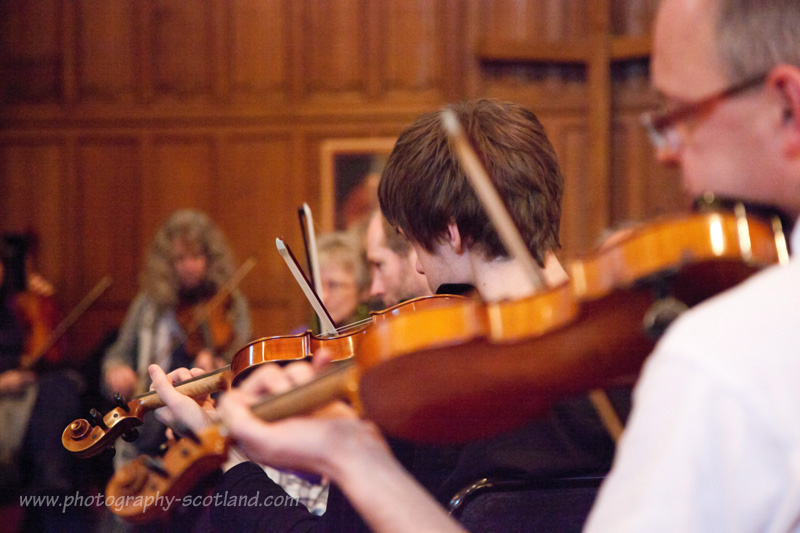
Fiddlers playing in an informal pub session in Edinburgh
Photo ©Ros Gasson 2014

After the class several of us went along to the session in the Diggers pub. The session is on Tuesday evenings from 9pm , in the back room of the pub. You’re welcome to join us!


Shetland bowing patterns

Shetland bowing patterns for playing reels

Last night we learnt the Shetland tune Sleep Soond i’ Da Morning. It’s a simple 16 bar reel.

Shetland players have distinctive bowing patterns used in playing reels. Patterns have a big influence on the sound, particularly the rhythms within the tune. The 1 down 3 up bowing pattern puts the emphasis on the on beat. The 3 up 1 down pattern puts emphasis on the off beat. We used both patterns in this tune, to shift the emphasis from the beat to the offbeat.

We worked on tapping foot when playing the 3 up one down bowing pattern. With this pattern, the bow emphasis falls on the off beat, while the foot continues to tap on on beat. It can feel a bit disconcerting when you first try it!

To get the best effect of these bowing patterns, we were speeding the bow up when playing the down bow, to add a strong emphasis to the note.

We also spent some time in the class talking about how to change the strings on a fiddle. I’ve started creating a new resource on the website, with some information on basic fiddle maintenance. If there’s any other areas you’d like me to cover with this, let me know!

Shetland bowing patterns for reels played on the fiddle
Photo ©Ros Gasson

Tips for playing in tune

Tips for playing in tune

One of the challenges of learning to play the fiddle is learning to play it in tune. The first step in this process is learning to hear what ‘in tune’ sounds like. Start off by learning to tune your fiddle by ear. If you’re not used to doing this, try it, and then use an electronic tuner to check if you’ve got it right. If you regularly try to tune by ear first, you will gradually learn to hear what the notes of the open strings should sound like. Going through the same process each time you do this is also helpful – start with the A string. If you can, tune this to a fixed pitch instrument, or a note from a tuning fork. Once you have the A in tune, tune the other strings using the open A as a reference. Tune the strings in the same order each time you do it (people commonly tune the A, then the D, the G, then the E). You might also find it helpful to always flatten the string before you try to tune up, so you are always tuning the note from flat to sharper. Once you think it sounds in tune, check it against the electronic tuner, to see if you have it right. The more often you do this, the more your ear will learn to hear quite subtle differences in tuning.

Tips for playing in tune on the fiddle
Photo ©Ros Gasson

We tried out playing through the first part of Professor Delbert’s Birthday, the jig we learnt in the class last week. The jig is in A major.

Then we spent a bit of time working on our tuning. We tried playing some notes from the A scale, against an A drone. Alternate people around the circle played the open A drone, while the people in between played A, B, C#, D, C#, B, A. Then we swapped round. The people playing the drone were concentrating on playing with a clear  tone. Those playing up the scale were listening to the tuning of their notes against the drones being played on either side of them.

After this we tried out playing in smaller numbers. One person played a long note from the A arpeggio. The next person round the circle played a different note from the arpeggio along with it. Then the third person round the circle played another note from the arpeggio. The first person dropped out, and the fourth person then joined in with another note. We continued this around the circle, with everyone listening to their tuning in relation to the people playing around them.

The B part of the jig has a lot of string swapping – there are several notes alternating between the A and E strings, which can be tricky to play and keep under control. We looked again at the technique for using a wrist action to move the bow from one string to the next and back again.

Jig rhythm

We also revisited the jig rhythm, playing it with a dotted timing. When doing this, the middle note in each group of 3 quavers becomes shorter. It can vary from a little bit shorter than the adjacent quavers, to almost not there at all (we discovered homeopathic fiddle notes!). It’s important to make sure that the tune doesn’t speed up when doing this – if the middle of a group of 3 quavers is shortened, the first note needs to be lengthened by the same amount, to keep the timing of the tune consistent.

Timing

We also tried out alternate people round the room playing drones on an open D, while the people in between played a slow D scale. When we did this, we tried it with no one obviously taking charge of the tempo. Everyone playing the scale needed to be aware of what the other scale-players were doing, to try to play in time with one another. People noticed that when no one was ‘in charge’ it could be hard for some people to hear what was happening. So they were aware of watching other people’s feet (if they were tapping their feet), or watching bows or fingers moving, to keep in time. If you’re playing with other people, sometimes you might find yourself in situations where it’s hard to hear what other people are playing, so developing an ability to see what’s going on is a useful skill to help with playing in time.


We have one more class this term, then a week’s break for Easter. It will be possible to enrol for next term at the class next week.


Tips for improving tone

Tips for improving tone

We started tonight talking about various things we can do to improve our tone when playing the fiddle.

Bow hold

We looked at our bow holds – it’s important to be able to keep the hand, arm and shoulders really relaxed when playing, right throughout the bow stroke.

We also looked at the role of the first finger and the pinkie. We can increase the volume by ‘digging in’ to the bow with the joint of the first finger, or play more quietly by using a little pressure on the pinkie, on the end of the bow, to take some of the weight of the bow from the strings. We tried both of these options out while playing a long drone on the A string,

We tried playing a D scale, with alternate people in the class playing an open D drone. We all paid attention to our tone while doing this. The fiddlers playing the scale also focused on tuning, listening to the D drone either side of them for reference. Then we switched round, so those who had been playing the scale played a drone, while the others moved to playing the scale.

Tone and the bowing arm

We also talked about transferring the weight of the bowing arm into the bow. We can use pressure on the forefinger to dig the bow into the fiddle. If we have the weight of the arm behind this, it adds a lot more impact, and allows us to really round out the tone of the instrument, making a much fuller sound. We put down our fiddles and split into pairs again. The first person acted as the ‘player’, and held their bowing arm out. They were aiming to get the feel of letting the full weight of their arm fall on their bow. The second person supported the player’s bowing arm at the elbow. The player let their shoulders fully relax, and allowed the full weight of their arm to be supported by their partner. It’s surprising how heavy an arm is! Once this felt natural, the person supporting the arm moved their supporting hand to the player’s wrist. The player then relaxed to allow the weight of the arm to transfer down to the wrist. Once this had happened, the 2nd person moved their support to the player’s fingers, so they could transfer the weight of their arm to there. Then we tried to use the weight of the arm through the bow, while playing an open A string.

Rolling the bow slightly away from you, so the hairs are not lying flat on the strings, will help create a slightly purer tone, as less of the bow hair is in contact with the fiddle strings. The bow should be rolled so the the stick is pushed slightly away from you, with the hairs slightly towards you.

Tuning

To help with tuning, we played different notes from the D arpeggio. Alternate people in the circle droned on an open D, while others found a note from the arpeggio, and paid attention to getting it in tune with the drone either side of them. Then we played through a D scale, with alternate people playing a harmony a third below.

We also learnt the first part of the jig Professor Delbert’s Birthday – we’ll learn the B part next week. We tried playing the tune as a slow jig, with slurred down bows over the bar lines, which makes it sound very laid back. The music for the tune is on the written music page.


March, Strathspey and reel set

Putting together a march, Strathspey and reel set

Tonight we worked on the Strathspey we learnt last week, and put it into a march, Strathspey and reel set. The set of tunes is:

Corriechoillies Welcome to the Northern Meeting (march)

Cameron’s Got His Wife Again (Strathspey)

Brenda Stubbert’s (reel)

We started off by working on getting the snaps in the Strathspey more precise and in time. We were working on moving the bow really fast on the downbows in this phrase in the B part:

The snaps in the B part of the strathspey Cameron's Got His Wife Again

It added real energy to that part of the tune. After that we worked on the joins between the 3 tunes. We also played a chord accompaniment to Brenda Stubbert’s Reel

Learning a march, Strathspey and reel set
Photo ©Ros Gasson

Playing in the zone

Playing in the zone

Tonight we spent some time working on playing ‘in the zone’ – letting our subconscious take over from our conscious thinking brain.

We played the run D, E, F#, G, F#, E, D on an open D string. Then we played the same run with an open A making a chord with each D, E, and F#, and a B (first finger on the a string) making a chord along with the G. We tried out alternating the run on the open d string followed by the run with the chords. We were working on keeping our bow very close to the A string, even when we weren’t playing on it, so that it only took a small movement to change from not playing a chord to playing a chord. After that we tried playing the run on the open string, and added just  the G/B chord in. When we repeated it, we played all the chords with the open A, and played the G without a chord. Then we tried playing the chords on the way up the run, and the single open string on the way back down.

It was pretty loud with so many folk playing chords at the same time!

We learnt the strathspey Cameron’s Got His Wife Again. The tune is in D. It’s got a number of unusual jumps in it, and plenty of snaps that kept us on our toes. We’ll spend some more time working on the tune next week.

Getting into the zone

After the break we played around with the notes in the D scale. To get a sense of how it feels to play without using your conscious brain, it can be helpful to find something very simple and repetitive to play. Once you’ve got the pattern under your fingers, it’s easy to let go, and get into the zone. We are aiming to be hearing the music as we want it to sound when we’re doing this.

We started off by playing up and down a D scale several times together. Then alternate people in the circle played a chord with the bottom A (first finger on the G string) and an open D. They played this in reel time, and emphasised the beat. Everyone else joined in with playing the D scale, also emphasising the notes that fell on each beat. After this, we tried every third person in the circle playing a harmony to the D scale – they did this by playing a D scale as well, starting on the D when the ‘tune’ players reached the F#, so it was a third below the original D scale. The harmony players were emphasising the offbeat. Once we’d done that, we had one more go, where anyone could wander from their original part, and find harmonies or rhythms to play along with what was happening.

At the end of the evening we played through the strathspey again. Sometimes with fast runs of notes in a tune, playing in time can be tricky. It’s helpful to be really precise and definite with where each note starts, to help keep the timing under control. We worked on the phrase at the end of the B part, and tried out using the bounce in the bow to make the notes stacatto and crisp.

Playing in the zone
Photo ©Ros Gasson

Bow control

Bow control when playing the fiddle

We spent this evening looking at ways we can learn more about bow control. We started off by learning a new march – Corriechoillies Welcome to the Northern Meeting.

First of all, we looked at gaining more control of our bows when crossing strings. We played the opening phrase of Soldier’s Joy, using a ‘1 down 3 up’ bowing pattern:

Soldiers Joy riff

Initially we played the run of notes while trying to keep the bow quite close to both strings. Then we added in tapping a foot on each down bow (these fall on the beat in the tune). After this, we played the first 4 quavers as single notes, and added a chord onto both the F# notes in the second 4 quavers (using an open A for the chord). Doing this regularly will help improve bow control when moving from one string to another, as you start to get a feel for when the bow will hit the new string.

Soldiers Joy riff with chords

If the bow is very close to both strings when we play without chords, it only takes a small shift in the angle of the bow to create the chord when we repeat the notes. This small movement comes from the wrist, not the upper arm or shoulder.

We moved on to playing bow strokes on an open A string. Initially we were playing long notes, and tapping our feet as well. Then we played shorter notes, with a gap between each note, focusing on starting and stopping the note cleanly.

After this we played up and down a D scale. To start with, we played with alternate bows on each note:

Bowing patterns - single notes

We worked on playing the notes crisply and cleanly, using the ‘bounce’ in the bow on each bow stroke.

Then we slurred the notes together in pairs:

Bowing patterns - slurring notes in pairs

Finally we played using a 1 down 3 up pattern:

Bowing patterns - 1 down 3 up

To make this work, it’s important to make the down bow long and fast, then play the following 3 quavers using a slower bow speed. This makes the note played on the down bow louder than the other 3 notes. We were tapping our feet on the down bow (which is also on the beat).

Learning bow control when playing the fiddle

We also tried out playing Terribus followed by Corriechoillies. These two marches could be played along with Captain Campbell’s farewell to Redcastle, for dancing a Gay Gordons.


Fiddle technique tips

Fiddle technique – tips for fiddlers

The String Circle fiddle class website has a catalogue of posts I’ve written over time, explaining various points of technique for fiddle players. All these fiddle technique tips can now be accessed through the list of links at the top right hand side of this page.

If you’d like to receive an email when new updates are added here, you can subscribe to the mailing list using the box on the right.

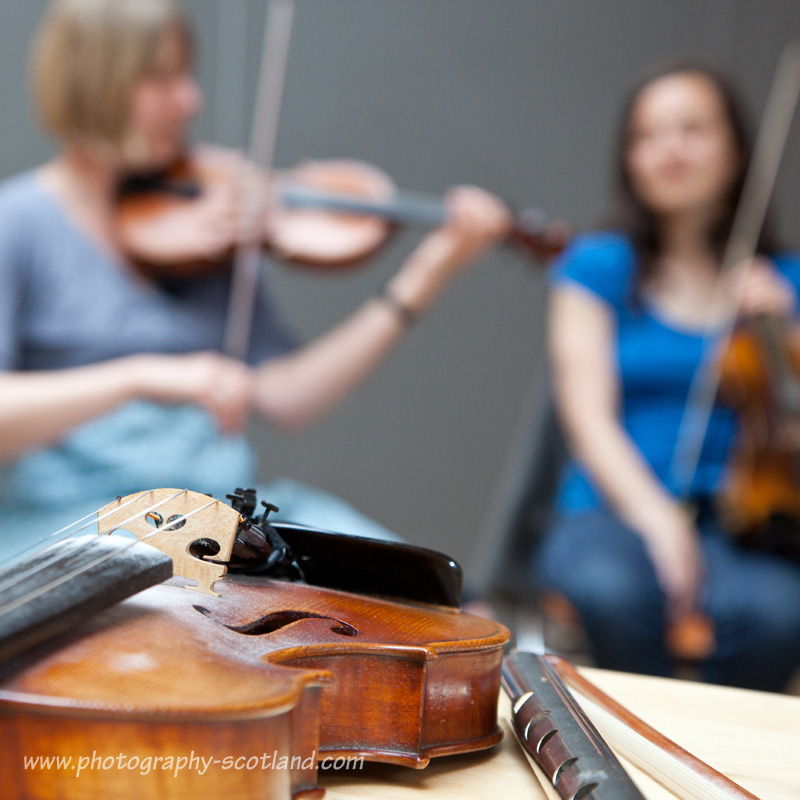
Learning fiddle technique in the String Circle fiddle class in Edinburgh
Photo ©Ros Gasson

The updates were primarily written for members of the String Circle fiddle classes and workshops which I teach in Edinburgh. They may also prove to be a useful resource if you’re are unable to attend  the class, and are looking for help with particular aspects of your playing.

If you are looking for individual fiddle lessons, to help resolve a particular issue with your playing, I occasionally teach 1:1. Have a look at the individual fiddle lessons page for more information.

The String Circle fiddle workshops are based in Portobello in Edinburgh. In our monthly one-day workshops we focus on learning technique, and generally enjoying ourselves on the journey! We’re also finding ways to develop a more relaxed and natural feel for the music we play.

Letting go when playing music

Letting go when playing music

Tonight we learnt the four part Irish Jig ‘The Lark in the Morning’. The tune is quite repetitive, with short riffs that are played round several times within each part. Part of the challenge of playing the tune well is to find ways to keep it sounding interesting.

We added rolls right at the end of each part.

We tried making the 3rd part sound like a lark singing. Here’s a short clip of a real lark in full flow. How close did we get?

Letting the subconscious take charge

Part of the trick to making our playing more expressive is to be able to let go, and play from the subconscious. When we learn a new skill that’s difficult to master (like speaking a new language, riding a bike, or writing) there is an initial stage where all the new things seems to be competing for our attention at the same time. As soon as you lose focus on one bit of the skill that you think you’ve just mastered, to pay attention to correcting something else, the first thing seems to slip backwards again. The trick is to get a new skill embedded into your muscle memory to a point where your subconscious brain can manage to control it – at that point your attention can focus in mastering the next bit of the skill. With learning something like the fiddle, there’s a huge amount to take in in the early stages, especially if you’re not particularly familiar with the style of the music as well. On top of grappling with holding the instrument and co-ordinating the bow movements and your left hand fingers, you’re probably also learning how to remember tunes by ear, as well as learning about the patterns and rhythms in the music. No wonder it all can all seem so hard sometimes! It can be easy to get into the habit of playing in a very conscious ‘thinking’ way, because we start off doing this when we’re first learning. So we looked at how to start moving away from this, and finding ways to experience playing in a more subconscious way.

The easiest way to do this is to find things to play that need as little concentration as possible to get the notes/rhythm right! So we started off playing a very simple riff in jig time, to practice playing the rhythm without the distraction of having to remember too many notes. Here’s what we played:

A short riff in jig time

Then we played a second riff, which would work as a harmony to the first riff:

A simple harmony to the first riff

Then alternate people round the room played the first riff, while the people in between them played the harmony. Each of us was able to hear our own playing a little more clearly, as the people either side of us were playing the other version. Once we’d done this, we played it again, but this time we stopped watching our fingers, or thinking about how we were playing. We focused instead on hearing how we wanted our own paying to sound, hearing the riff in our head as we played. We tried to hear it in a way that would make someone who walked into the room want to dance or clap along to us.

After this, we added in another option – anyone who wanted to could ‘wander’ from the riff at any time, and play anything they wanted to – another harmony, or a chord or drone. Or we could just stop playing at any time and listen to what other folk were playing. We were aiming to be aware of what others in the group were playing while we were doing this. Doing this for a while was quite hypnotic!

Once we’d done that, we tried playing through the Lark in the Morning again. We talked about what had felt different, in moving from playing around with the riff, and then changing to playing the tune. People found they could relax more when playing the riff, as there were no real ‘rules’, and apart from the rhythm, it didn’t really matter what you played. It felt much less pressured – and maybe more ‘playful’.

Letting go when playing music
Photo ©Ros Gasson 2013


Playing rolls on the fiddle

Playing rolls in a jig

When playing in jig time, you can play a roll any time when there are three quavers played together on the same note, or a dotted crotchet. Once you can play a roll fluidly, you won’t hear any of the individual notes involved in the ornamentation. When you’re first starting to learn to play a roll, you will play the note that’s in the tune, followed rapidly be the note above, the note itself, the note below, and back to the note in the tune. If you want to play a roll where the note in the tune is a B (played with the first finger on the A string), the fingering for this would be 1-2-1-0-1. (To play a roll on an open string note,  you can play 0-1-2-1-0.)

 Learning tunes by ear

We got onto talking about what you can do where you are familiar with a tune, but don’t necessarily have all the notes right under your fingers. When this happens, it can be easy to become tense at the bits of the tune you are unsure about, which generally exacerbates the problem. If you’re playing in a large informal group, such as a busy session, you can try quietly feeling your way around the tune while others play it. If you’re in a slightly more exposed situation, it’s good to have something to fall back on, so you know you can play, but won’t put others off in the bits you’re not certain about. We tried the following exercise:

We played a short riff on the e string:

jig time riff01

Then we split into two groups – alternate people round the room played just the notes in the run down:

jig time riff - on-beats

At the same time, the people in between played just the f sharps from the riff:

Jig time riff - off-beats

Then we tried swapping round, so everyone had had a chance to try each of these two options. People generally found it much easier to play the run down, than the repeating f# notes. When you listen to the riff being played, the notes in the run down all fall on the beat. They therefore all tend to ‘stick out’, and sound more obvious. It’s a useful thing to be aware of, if you’re playing a tune where you’re not entirely sure of all the notes. In this situation, if you aim to get the main notes in the tune, it gives you a skeleton, and an idea of the main shape of the tune. It also helps with keeping a steady rhythm, even if some of the other notes are missing or wrong! If the tune is played round a few times, you can then begin to pick up any of the other notes in between that you’re less sure of.

Playing faster

Once we’d done this, we used the riff to try working on playing faster. We played it round several times together at a steady pace, then took the speed up a bit. Once we had settled into the new speed, we tried taking the speed up a little more. If the riff became too fast for anyone to play, there was always the option to revert to playing just those key notes, as we did in the previous exercise. We tried the same thing again, but this time we avoided looking at our left hand fingers while we were playing.  We were aiming to hear the riff in our head as we played, and to play it in a way that would make someone listening want to clap along or dance. We found that it sounded more fluid when we played it like this.

The Hen’s March

At the end of the evening we went back to the Hen’s March and worked on the opening phrase in the tune. We added in some vibrato on the lead G, along with a crescendo on the G, and a grace note as well. Then we added a hammer on on the D at the start of the first bar (playing from a C# to the D), and a chord with the open D string below.


To finish off we played through Teribus together.


There will be no class on Tuesday 18th February.