Playing a fiddle in tune

 Playing a fiddle in tune

Tonight we spent some time looking at what happens when we start playing tunes in less commonly used key signatures, and what we can do to learn to play more reliably in tune. Up until now, we’ve learnt tunes that have been in the commoner keys such as D, A, A minor, and G. It has helped us to get very familiar with where the notes are in those keys.
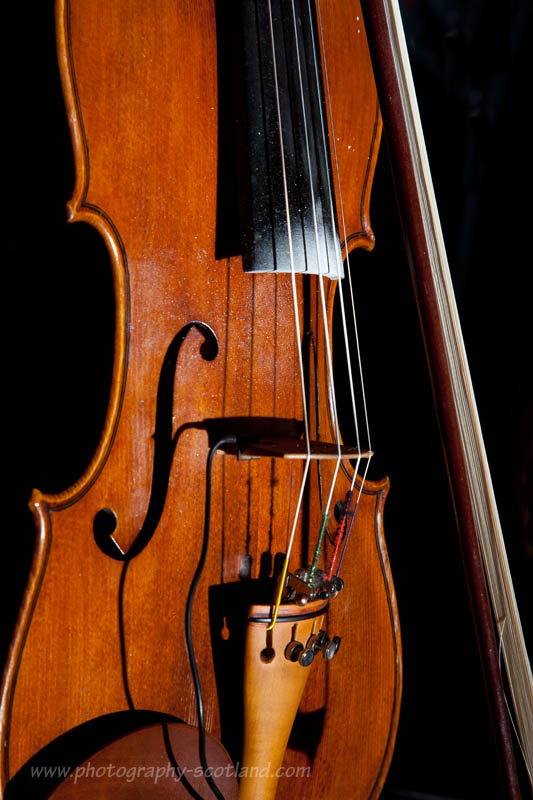
Tonight we learnt the A part of a waltz by Johnny Cunningham, called Leaving Brittany. The tune is in D Minor, which uses B flats and F naturals. So we need to move the first finger back towards the nut when we’re playing on the A string and the E string. (If you’re not sure where the nut is on your fiddle, here’s a labelled photo). The tune also has B naturals, and a mixture of C naturals and C sharps. We started  off by playing all the semi-tones from an open A string to the D on the third finger. Here’s how it works:

Open A

B flat (1st finger close to the nut)

B natural (slide 1st finger up to its usual position)

C natural (2nd finger, placed close to the 1st finger)

C sharp (slide 2nd finger up close to the 3rd finger position)

D (3rd finger in its usual position)

Once we’d played this run of notes through a few times, we had a sense of where the notes would be. We talked about ways to help with playing in tune. It’s very common when people are learning to play the fiddle that notes are played slightly flat. If you’re playing on your own, it can be difficult to hear slight differences in pitch if you’re not used to hearing what an ‘in tune’ note sounds like. We tried playing the same series of semi-tones from A to D, and played the open D along with out 3rd finger D. This helps us to hear if the D we’ve arrived at is in tune!

It can also be really helpful to play along with an instrument which has a fixed pitch (such as an accordion, concertina, or piano), to help to learn to play in tune. If you’re playing with other people who are also learning to play the fiddle, it can be difficult to work out whether you’re in or out of tune, when you can hear that you’re not playing quite the same pitch as the person next to you in the group. Making sure that you have tuned your fiddle each time you play it is also important.

Once we’d done this, we spent some time learning the A part of the waltz. The written music is on the tunes page. We’ll be learning the B part next week, and consolidating the tune.Playing a fiddle in tune

We also played through the Vals, and gave some thought to where we might put grace notes and ornamentation to add shape to the tune. We played through the Aird ranters, and also tried playing it in reel time. Because we’re familiar with where the notes are in this tune, we were aiming to play this more subconsciously, hearing the new rhythm as we played.


We played through several reels together at the end of the evening – the Barrowburn Reel, the High Road to Linton, Spootiskerry, the Islay Rant, and Ramnee Ceilidh. we finished off with the march Dorothy and John Livingston (which is a lovely tune to play for a Gay Gordons).

Playing waltzes

Playing waltzes on the fiddle

Tonight we learnt a Norwegian tune, called Vals, which is in the key of G. It’s a beautiful waltz, written by Vidar Skrede. Because the tune is Norwegian, there are some phrases that don’t go where we expect them to! In the second part, the tune has an awkward octave jump from a B to a high B (played with the pinkie on the E string). It’s not an interval we’re used to playing, so needs a bit of practicing to get in tune.

If you’re struggling to get particular notes in tune, it can be helpful to play through the tune with an electronic tuner switched on. Play the tune a couple of times without looking at the tuner, to relax into it. Then when you get to a note you’re having trouble keeping in tune, stop playing the tune, but keep playing that note. Have a check on the tuner to see whether it’s flat or sharp. It will help to give you an idea of where the problem is. If you try this, you might also find that it’s the note before or after the one you  were worried about that is actually the problem.

Playing waltzes on the fiddle
Photo ©Ros Gasson 2011

As the waltz is a tune for dancing, we worked on ways to help play the tune with a bit of a swing to it. We tried out adding a bit of a ‘spring’ in our bow strokes. Using single bows, we used the weight of our bowing arm, transferred through the first finger, to ‘dig in’ to the note at the start of each bow stroke. The natural spring in the wood of the stick then lifts the bow just clear of the string at the end of the note. The bowing hand is continually shifting between transferring the weight of the arm into the bow, to gently supporting the bow as it lifts off the strings, and staying relaxed throughout.

We also tried out giving a ‘shape’ to the longer notes in the tune. it can be very effective to speed the bow up throughout a longer note, to create a crescendo within the note. Grace notes and vibrato also add different effects. Once we had the notes of the tune sorted out, we played it through without looking at our hands, listening to the other fiddlers in the room, and focusing on playing together as a group. Getting into the habit of playing music more subconsciously, without concentrating on where our fingers might be going, will ultimately help us to play music more fluidly and expressively.

Towards the end of the evening, we played through the Aird Ranters. we also learnt a bass riff to play under the tune, which adds a good drive to the music. we rounded off the evening by playing Ramnee Ceilidh, and Midnight on the Water.

And if you sometimes find it hard learning to play the fiddle, have a look at this for a bit of light relief 😉 The Seagull, played by the New Rope String Band


There will be no class on Tuesday 12th February. We’ll add an extra class on at the end of term, on the 2nd April. (UPDATE – this has now been changed to 9th April!)


Bowing patterns and rhythm

Bowing patterns and rhythm

Tonight we spent some time thinking about different bowing patterns and how they affect the rhythms in tunes we’re playing. We started off by playing through the Jig we learnt in the first week of term – The Road to Banff. When we first learnt this, we played it with a dotted rhythm, emphasising the 2 main beats in the bar. Tonight we looked at changing the emphasis to the upbeats in the first phrase. It adds a real lift to the tune, and gets peoples’ feet tapping!

We learnt the strathspey The Aird Ranters (by Fred Morrison). It’s a short and straightforward tune to play on the fiddle. Once we’d learnt the notes, we tried playing it down an octave.  We spent some time thinking about our bow holds, getting a relaxed hold on the bow, and keeping our thumb slightly bent to avoid building any tension in the forearm. We talked about using the thumb as a pivot. Adding a bit of pressure with the pinkie can be used to take the weight of the bow when we lift it off the fiddle strings. If we want to really ‘dig in’ with a note, we can do this by adding a bit of pressure with the first finger as we play the start of the note.

We tried out playing some long slow open strings, thinking about tone. Keeping the bow perpendicular to the strings, and the bow hold relaxed helps to create a full tone. Then we tried playing as quietly as we could manage, by using a little pressure with the pinkie to take some of the weight of the bow off the strings.

We tried out a couple of different ways to bow the opening phrase to the strathspey. Using a down bow at the start of the tune, and playing single bows, results in a big emphasis on the 3rd note. we also tried out playing  a down bow followed by 3 up bows, which gives a much lighter feel to the start of the tune.

Bowing patterns and rhythms
Photo ©Ros Gasson

At the end of the night we played Captain Campbell’s, and tried out playing the Aird Ranters while adding in some dynamics, by dropping the volume in the B part of the tune.

Bowing jigs on the fiddle

Bowing jigs on the fiddle

Tonight’s class focused on bowing jigs on the fiddle. We started the new term by checking what everyone in the class wanted to work on over the coming weeks. The main themes seemed to be bowing, playing rhythmically, and learning to play faster.
At the beginning of the evening we looked at our bow holds. It’s important to be able keep the bow hand relaxed throughout the full length of the bow stroke.

A fiddler playing, viewed from behind
Photo ©Ros Gasson

The thumb should remain slightly bent to prevent tension creeping up the forearm. The fingers are curved over the stick of the bow, to give a relaxed hold. The fiddle takes most of the weight of the bow when we’re playing, so the hand can be thought of as just guiding the bow rather than gripping or holding it. When we’re playing, the thumb acts as a pivot – we can add a bit of pressure with the pinkie to take some of the weight of the bow off the strings and create a lighter sounding tone, or we can add pressure with the first finger to really ‘dig in’ to the start of a note to add emphasis. When we’re playing, the whole hand should be slightly rotated anticlockwise (if you’re using your right hand). Doing this  puts the wrist into a comfortable position to bend and flex at the top and bottom of the bow stroke.

We spent some time playing long bow strokes while thinking about our tone. We worked on keeping the bow perpendicular to the strings and keeping the bow fairly close to the bridge while we played. We tried playing a jig rhythm on an open A. There are 6 quavers in the bar in a jig. We are aiming to learn a basic bowing pattern for playing jigs, which we can play subconsciously. Once we have a pattern learnt in this way, it opens up possibilities for us to play around with the bowing patterns and rhythms, as we’re not having to think about the basic mechanics of how we are bowing the tune.

Once we’d picked up a dotted jig rhythm on the open string, we split into two groups.Half of each group played the jig rhythm on an open D while the others were playing on the open A. We tried to keep a steady rhythm, and listen to others in the group, while using our first fingers to ‘dig in’ with the bow at the start of the first beat in each bar, to add emphasis.

After the break we learnt the jig The Road to Banff. The written music is on the tunes page. We’ll be spending some more time on this tune next week.

We spent some time taking about playing for dancing. Jigs are commonly played for the Strip the Willow. Four 32 bar jigs in a set would be enough for each couple to go through the dance twice.

At the end of the evening we played Jig Runrig, the Road to Banff and Rory Macleod. Then we played Campbell’s Farewell to Redcastle, which we learnt in the class last term.

New term for the fiddle class – January 2013

A new term for the string Circle fiddle class

It won’t be long now til we start a new term with the String Circle fiddle class. The class has been running for over 5 years already. The class was initially taught by Mairi Campbell, as part of the Scots Music Group in Edinburgh. I took on teaching the class in 2009, and it became independent in 2011 when the Scots Music Group underwent a major reorganisation.

Learn to play the fiddle in the String Circle fiddle class in Edinburgh

I’m planning on having  a real focus on bowing this term. We’ll continue to look at our bow holds, and find ways we can keep a relaxed grip while we’re playing. We’ll also be spending some time investigating different ways to bow a selection of new tunes, and getting a better sense of how different bowing patterns influence the rhythms in the tunes we’re learning.

Enrolment has started for the String Circle fiddle class for the January term, which will run for 12 weeks from Tuesday  8th January 2012. Please contact St Bride’s (in Orwell Terrace, Edinburgh) to enrol before the new term starts. Telephone 0131 346 1405 or email amanda.gray@ea.edin.sch.uk.

If you have never played fiddle before, and are keen to start learning, the Scots Music Group and Portobello Fun Fiddle are both starting new absolute beginners fiddle classes in January 2013

Playing tunes subconsciously


Playing music subconsciously

Playing fiddle music subconsciously
Photo ©Ros Gasson

We spent some time tonight thinking about making a shift from thinking consciously about the mechanics while we’re playing tunes, to playing music while just thinking about the sound of the tune we are playing, and allowing the subconscious to ‘take charge’ of how that happens. Once we’ve learnt some basic techniques, we need to find a way to start to focus on the sound we are producing. We’re aiming to begin to hear the tune in our head, the way we would like it to sound, as we’re playing it. Ultimately the mechanics of creating the sounds become so automatic that hearing  a tune in this way becomes enough to allow us to automatically play it the way we are hearing it. It’s a process we go through for any new skill we learn. At some point, the new skill becomes a subconscious action, and at that point, the action flows much more smoothly than when we were consciously thinking about how to make it happen. The subconscious brain is an amazing thing when it comes to playing music!

One of the ways we can start to make this shift is to play without looking at our fingers. In the class, we’ve been trying out playing while standing in a circle, thinking about the tune, and looking at the other fiddlers in the group, rather than our own hands.

We learnt the Gordon Duncan tune ‘The High Drive’ in the class tonight. There are several different versions of this tune around. The music for the version we learnt in the class is on the website music page. The original tune is written with 4 parts, but all four parts are rarely played in sessions. It’s commonly played as a two part reel.

We had a bit of a chocolate-fest in the break!

We ended the evening playing through a number of tunes together.

Thanks to everyone who has been in the class this term. It’s been a lot of fun, and a lovely group to teach.

Enrolment for the spring term starts on 10th December. Contact the office at St Bride’s for more information. The new term will start on Tuesday 8th January 2013, and will run for 12 weeks (without a mid-term break) until Tuesday 26th March. I hope to see you then!

Fiddle technique recap

Fiddle technique recap

Tonight we had a fiddle technique recap, going over various aspects of technique that we’ve worked on during the term. We played through all the tunes we have learnt in the class since September, and reminded ourselves of some of the things we worked on when we first learnt them.

Roxburgh Castle (reel)

We went over some of the things we can do to help us to be able to play reels faster:

  • Use short bow strokes.
  • Think about bowing patterns.
  • Keep our bow close to the strings when we’re crossing from one string to another – minimise the vertical movement in the tip of the bow.
  • Use a circular wrist action to help with crossing from one string to another.
  • keep our fingers close to the strings when we lift them off.
  • Keep fingers on the strings where possible, if we’re coming back to the same note.

We tried playing the tune without looking at our fingers, to help with playing more from our subconscious.

Ramnee Ceilidh (reel)

We went over the second part of the tune again, and worked on the syncopated rhythm.

I See Mull (slow air)

We’ve been working on different aspects of  fiddle technique to help create a good tone on the fiddle:

  • Keep the right hand thumb bent and relaxed. It’s important not to let tension creep into the bowing arm.
  • Use the thumb as a pivot, and add a little pressure on the pinkie. This takes a bit of the weight of the bow off the fiddle. It’s  especially helpful when we’re playing on the e string.
  • Use pressure on the bow with the first finger to ‘dig in’ to a note.
  • Keep the bow perpendicular to the strings throughout the bow stroke.
  • Keep the bow close to the bridge.
  • When lifting the bow, bring it back down onto the strings close to the heel of the bow. Get the bow moving in a down bow direction before it actually hits the string.

We played through the tune, and then played it down an octave.

Danse des Petit Filles – Dance of the Little Girls (waltz)

We played the tune, and some of us played through the harmony. We broke into pairs and practiced playing single long down bows, lifting the bow between notes, while our partner checked if our bows were perpendicular to the strings.

At the end of the night we played through some of our tunes together

We started off with Fionn’s (a tune from last term) and then played The Aird Ranters, The Devil in the Kitchen, Brenda Stubberts, and Jenny Dang the Weaver.

Next week is the last week of term. Anne seems to want chocolate cake for some reason! 😉

Fiddlers playing together
Photo ©Ros Gasson

How to play triplets on the fiddle

Learning how to play triplets

Tonight we learnt the Strathspey Devil in the Kitchen, a Scottish pipe tune, which gives us a great oppotunity to focus on how to play triplets. It was composed by the piper William Ross. It’s a good tune to get under our belts for practicing playing triplets, as there’s plenty of them in the A and B parts. The written music for the tune is on the website music page. We’ll find another tune that we could put into a set with this one for Anne!

Playing jigs on the fiddle
Photo ©Ros Gasson

It’s important to have a relaxed hold on the bow, and to use movement in the wrist and fingers to produce the triplet. Using upper arm movement would make it hard to play the triplet with any precision. We’re aiming to play the triplets in this tune using down-up-down bowing for each one. The three notes are very short, and only use a tiny bit of the bow. The action is created by making a short strong down bow on the first note in the triplet. By bringing that down bow to an abrupt stop, the bow then ‘judders’ up and down, creating the 2nd and 3rd notes in the triplet.

Here’s a video from Blazin’ Fiddles fiddler Bruce McGregor

We also thought about how we might add dynamics into the tune, with quieter or louder parts to add some expression.

In the break in the middle of the evening, we nipped next door to see the photography exhibition  😉 …and we had some chocolate cake, too.

It seems that the research into who uses what type of vibrato is ongoing – our class theory seems to be standing up well, with only one exception found so far!

After the break, we played through Roxburgh Castle again. We spent some time working on using a circular action with our wrist to help with the string crossing in the B part. Again, it involves using quite a short length of the bow for each note, and keeping the bow moving by using the wrist and fingers. This gives us fine control over what we’re doing with the bow, and will help with starting to play the tune faster. We could play this part of the tune without moving the upper arm at all.

We ended the class by playing a few tunes together.

Learn how to play triplets in the String Circle fiddle class
Photo ©Ros Gasson


Playing fiddle harmonies

Harmonies on the fiddle

Tonight we started the class by going back over the waltz we learnt last week, then we learnt a harmony to play along with it. The written music for the harmony is on the music page. The tune and the harmony have short phrases which repeat several times. Listening to the tune while you’re playing the harmony will help us to hear how these parts fit together.

The B part of the harmony is a set of simple repeating chords, played on the A and E strings. We broke into pairs and one person played the chord sequence while their partner gave them feedback to help them keep their bow perpendicular to the fiddle strings. We then spent some time looking at how to improve our tone while playing these chords.

* We’re playing a long down bow followed by two up bows and lifting the bow up off the strings in between each chord. As we were bringing the bow down onto the strings for the down bow, we tried getting the bow moving downwards before it hit the strings.

* We practiced playing the down bow as a long bow, starting at the heel of the bow, and playing right to the tip. Bringing the heel of the bow onto the strings, rather than the centre or tip of the bow, gives us a lot of control over when the bow actually starts to come into contact with the strings.

* We tried playing with slightly less pressure on the A string than the E string.

* It’s worthwhile practicing playing chords as much as possible when you’re practicing alone, where you can hear both notes, and hear when they are in tune with each other. Playing chords is a great exercise for hearing tuning more clearly.

We played through Roxburgh Castle, and then went over the chord accompaniment that we learnt for the tune.

We finished off the evening by playing through Ramnee Ceilidh and Da Merrie Boys of Greenland.

Learning harmonies in the String Circle fiddle class, Edinburgh
Photo ©Ros Gasson

Working on tone on the fiddle

Developing tone on the fiddle

We spent tonight’s lesson doing some more work on our tone. We started by playing through the tune from last week – I See Mull. Then we learnt a new waltz – Dance des Petit Filles (The Dance of the little Girls). The written music is on the music page. It’s an unusual tune, and turned out to be quite a challenge to learn!

After the break, we did some more work on our tone on the fiddle. We split into pairs, and gave each other feedback about our bows. We started off focusing on keeping the bow perpendicular to the fiddle strings, then worked on playing with the bow closer to the bridge.

Bow hold

Developing a relaxed and comfortable bow holdwill also help us play with a more mellow tone.

Fiddle lessons in Edinburgh - improving tone in the String Circle fiddle class

We put down our fiddles for a while, and worked on our bow holds. If you drop your bowing arm down by your side (without holding the bow!), and shake it out, your hand relaxes. You can keep the hand in this relaxed position, and raise it up in front of you, and place the bow into it. It gives an idea of how relaxed the bow hold can be when you’re playing. Getting into a habit of doing this before picking up the bow to play will help develop a more relaxed bow hold when playing.

It’s particularly important to keep the thumb relaxed and slightly bent.

We tried out moving the bow through long bow strokes, to get the feel of having a flexible wrist when we play.

The we talked about how the 1st finger and the pinkie are important for helping to keep control over our volume when we’re playing. The thumb acts as a pivot for the bow. If we put a bit of pressure on the pinkie when we play a bow stroke, it takes some of the weight of the bow off the fiddle strings. The lighter bow plays much more quietly, with a delicate tone. We tried this out on out fiddles. Conversely, pushing down with the forefinger pushes the bow into the strings, giving a scrunchier louder sound to the note.

Creating dynamics

We went back to the waltz we learnt earlier, and tried thinking about where we might change the volume of our playing, to help it to become more expressive. We also tried out changing our bow speed to help create a crescendo within some of the longer notes in the tune.

At the end of the evening we played through a few tunes – we played Mrs MacLeod of Raasay, Willafiord and Roxburgh Castle as a set. We also played Fionn’s, a tune by Charlie McKerron which we’ve learnt previously in the class.