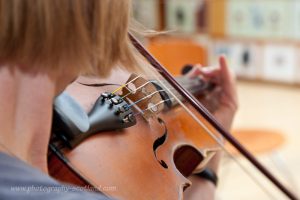
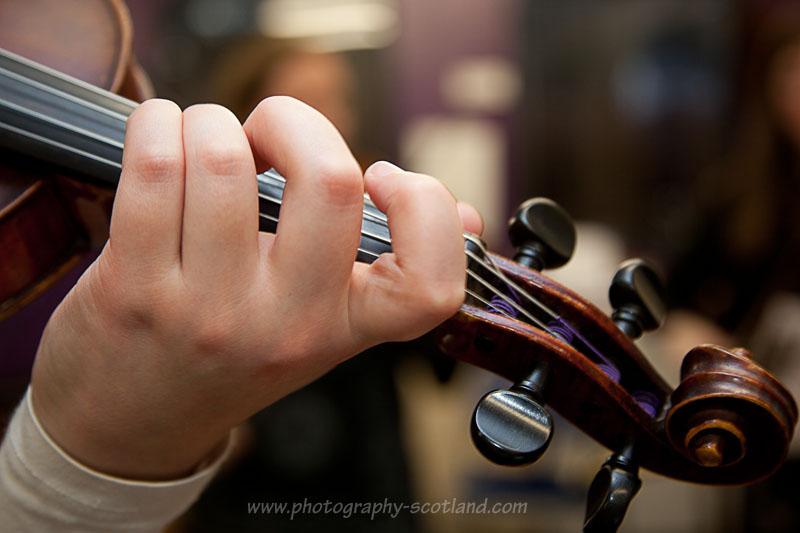
Tonight we learnt Bill Sullivan’s Polka, and spent the evening working on techniques for playing polkas with a ‘bouncy’ rhythm. We were using our first finger to push down into the notes, allowing the bow to bounce just clear of the string in between notes in the tune.
We also played around with a chord version of the B part of the tune – it can be played as a variation on the tune, or as an accompaniment along with the tune. We tried experimenting with different rhythms.
We worked on technique for playing chords within the tune in the A part. We were playing an open A along with parts of the tune that were played on the D string. We tried out playing the tune on the D string while keeping the bow just clear of the A string, but very close to it. By pushing down on the stick of the bow with the first finger, the bow hairs are compressed so they also touch the A string. This can be done without changing the angle of the bow on the strings at all, and allows a lot of control over which of the notes in the tune the chords are played on.
We played through several tunes at the end of the class – Road to Banff, Leaving Brittany, The Eagle’s Whistle, and finished off playing through Lay Dee at Dee.
At the end of last week, we ended up with a question: “How do you play notes that sound crisp on the fiddle?” We looked at some techniques we can learn that will help with this, in the class tonight. We started off by thinking about what it is about the sound of musical notes that makes them sound crisp and clean to the listener. Some ideas that came up included:
the notes are in time
the notes aren’t rushed
the notes have a definite start and finish
there’s a ‘shape’ to the notes
there might be a small gap between one note an the next
the notes are expressive
the notes have a good tone, creating a sound that’s pleasing to listen to
We used the tune we learnt last week to look at some of these attributes. We started off by talking about learning how to play at a steady tempo. Becoming confident that you can hold a tune at whatever tempo you wish to play it is a skill that can be learnt over time.
It can be useful to try to play along with a metronome. If you’re doing this, and you tap your feet while you play, it’s helpful understand what’s happening with your foot tapping before you try this out. If your playing follows the tempo that your foot is tapping, you’ll need to work on tapping your foot in time with the metronome in order to be able to play in time with it. If on the other hand, your foot tapping is following your playing tempo, then you can aim to match your playing directly to the metronome’s speed.
In the class, we tried out starting off playing the tune at one tempo, then moving to a new tempo at the start of each tune part. The group was following one person for this exercise. Initially we found that although we all changed quickly to the new tempo, there was a tendency to immediately slide back towards the previous tempo we’d been playing at. We were also working on tapping our feet while playing, to help with establishing the beat.
Playing with ‘bounce’
We then went on to work on using the vertical action of the bow in the bow stroke, to create ‘lift’ in a run of notes. As we draw the bow across the strings, the bow can be slightly compressed downwards, by using the first finger on the back of the stick to transfer the weight of the arm into the bow. Releasing this pressure part way through the bowstroke will make the bow ‘bounce’ out of the end of the bow stroke. By varying the pressure applied, and the point at which we release that pressure, it’s possible to vary the slight gap in between successive notes, created when the bow lifts just clear of the string.
We concentrated on the B part of the tune, and tried out using bowing patterns to create emphasis on the beat. The Shetland style ‘1 down 3 up’ bowing pattern can be used on the runs in this tune to great effect.
We also had a go at using chords to create emphasis. In the A part we have already tried out creating a percussive chord on the beat, on the opening D in the tune. This week we tried playing a chord in the B part, playing the D and F# (on the E string) together. We played these on the offbeats in the string-crossing section at the start of the B part.
We tried out using various bits of technique together to create a different effect. On the opening D of the tune we used increasing bow speed, hammer on plus a chord with the open D below, to create crescendo in the note, giving it a ‘shape’.
To finish the class we played through Cooley’s Reel together.
Next week we’ll learn a polka, which will give us a chance to do some more work on developing those crisp notes!
The String Circle fiddle class met for the first night of term this week. We’ll be learning various aspects of fiddle technique throughout the 12 week term.
Tonight we learnt the Shetland reel Lay Dee at Dee. We looked at bowing, and tried out slurring 2 notes either before or after the crotchets in the tune, to keep a bowing pattern with down bows on all the on-beats. In the A part of the tune, we looked at playing a percussive open D along with the Ds in the tune itself. In the B part, we worked on the section with string crossing between the A and E strings.
We tried out using a circular wrist action to get the bow crossing from one string to the other. To do this effectively, you need to play the notes a little further up the bow than your usual playing position. The weight of the bow can then be used to allow the bow to tip over from the E string and onto the A string.
We also tried out playing up and down a D scale, while thinking of something unrelated to what we were doing. We were aiming to allow the playing to be taken care of by the subconscious part of the brain. It’s worth trying this out at home. Try playing something you are really familiar with ( a scale, or riff, or a tune you know really well). Find something to watch that will keep you absorbed – looking out of the window, if there’s something happening outside, or watching the tv with the volume turned down might work. Playing round your chosen piece, while getting your conscious brain absorbed in something else, will mean that the subconscious will have to take over dealing with playing the fiddle. This will give you an idea of how it feels to play in a way that will allow the music to flow more naturally. When we first start to learn to play the fiddle, the conscious thinking part of the brain takes over. As we play, we’re analysing and thinking about everything that goes on, as we grapple with where to put the bow, which finger is going down next, whether we are playing in tune and in time, and a myriad of other details. The overall action of playing doesn’t flow well when the brain is working in this way. It’s similar to when we learn a skill such as reading – in the early stages, when we read out loud, the words came out in a rather stilted way, as we were having to consciously work out what each word on the page was. As we became more familiar with the shapes of common words, we learnt to read more fluidly, from the subconscious rather than the conscious.
We talked a bit tonight about effective ways to practice. Here’s a link to the blog post I mentioned about practicing without your instrument. There are loads more interesting blog posts on the same website, covering all sorts of aspects of the psychology of music, playing and learning.
Next week we’ll do some more with the tune we learnt tonight.
Tonight we learnt an unusual jig written by the fiddler Sarah Northcott. Sarah wrote the tune for a couple of friends from Brittany, for their wedding day. It’s called ‘Anne et Ludo’. It’s a quirky tune, with notes slurred over the bar lines in both the A and B parts. We worked on speeding the bow up on the second of the slurred notes, which falls at the start of the bar, to emphasise it. This helps to keep a steady rhythm throughout the tune.
We also played through The Shetland Molecule a few times, and reminded ourselves of some of the bowing patterns we tried out last week.
At the end of the night we played through several tunes we’ve learnt in the last two terms: the Aird Ranters, The road to Banff, Vals, Leaving Brittany, Break your Bass Drone, and the Eagle’s Whistle.
This was the last class of the summer term. We’ve covered a lot of topics, with a focus on using bowing to play around with rhythms in a tune.
The autumn term starts back on Tuesday 10th September. Details are on the website home page.
Tonight we spent some time working on developing a basic pattern for bowing reels, and also looked at a couple of variations for this, to shift the emphasis from the beat to the off beat.
We started off by playing through some bowing exercises for reels. We played up a D scale, playing each note twice, using single bows. If we start on a down bow, each full scale becomes the equivalent of 2 bars played in reel time. When all the notes in the pattern are quavers, playing a simple pattern of alternating down bows and up bows will always bring us back to a down bow on each on-beat and off-beat in the tune. If we add either a crotchet or a triplet into the notes, we need to slur two notes to get our bow back into the ‘down bow on the beat’ pattern. In the exercise we worked on slurring the two notes immediately after the crochet or triplet.
We learnt the reel ‘The Shetland Molecule’ by John McKusker, and worked on slurring 2 quavers together after each triplet or crotchet in the tune. Once this bowing pattern was established, we tried varying the pattern in a few places, to move the emphasis onto the off beat.
We revisited our bow hold, looking at the importance of keeping the bowing fingers, hand and arm relaxed. It’s particularly important to make sure that the thumb is slightly bent throughout the bowstroke, to prevent tension creeping into the bowing arm.
At the end of the evening we played through Jig Runrig and the Road to Banff
Tonight we worked on bowing reels with a down bow on the beat. We’re aiming to develop a ‘default’ bowing pattern, so that we can play reels emphasising the on beat naturally, and completely subconsciously. Once this pattern is ingrained, it becomes much easier to learn techniques and bowing patterns that will enable us to play around with rhythms in the tune.
Bowing reels
We looked at Coolies Reel as an example. Each time there is a crotchet or triplet in the tune, we slurred the following 2 quavers. (It’s possible to slur the preceding 2 quavers instead, if you prefer).
We also looked at an option for adding an extra slur in the B part, to push the emphasis onto the offbeat.
Grace notes and rolls have a percussive effect on a note in a tune. Although often written as playing extra notes, you don’t hear grace notes as individual notes. They are an embellishment of the note in the tune. A simple grace note acts by briefly stopping the string from vibrating. You can use the finger above the note, or the 2nd finger above the note to create a simple grace note. The hand needs to be really relaxed. The finger action is a very short tap on the string, and is just enough to stop the string vibrating for a moment.
Rolls
Rolls have more fingers involved! They can be played as 5 or 4 note rolls. As with grace notes, once you can play these fluidly, you won’t hear any of the individual notes of the ornamentation. When you’re first starting to learn to play a roll, you will play the note (already in the tune), followed rapidly be the note above, the note itself, the note below, and back to the note in the tune. For a 5 note roll on a B (played with the first finger on the A string), the fingering for this would be 1-2-1-0-1. A 4 note roll starts on the note above the note in the tune (fingering 2-1-0-1 if played on a B). Rolls on an open string can be played 0-1-2-1-0.
Chords
Playing with relaxed hand – we tried out playing with a very light bow hold, holding the bow with just the thumb and first finger. It’s possible to play the whole tune like this, as long as we don’t try to lift the bow off the strings at any point. This is purely an exercise! It gives an idea of how little pressure you need from your 3rd & 4th finger, and pinkie, while playing most of the tune. Those fingers are generally relaxed, and laid over the bow, giving it a bit of stability during the bow stroke, and keeping the bow running in a straight line, perpendicular to the strings. The pinkie will be used a lot more if we’re lifting the bow off the strings.
We worked on techniques for playing chords in the tune. If we’re playing part of the tune on the A string, and want to create chords on the D string, we can make this much easier by keeping the bow as close as possible to the D string throughout the bow stroke. When we want to include a chord, a small bit of pressure on the stick of the bow will then be enough to bring the bow hairs in contact with the D string as well.
We also tried out playing an open A, with a more percussive style of chord on the open D, on each down bow. Playing close to the heel on the up bow results in there being plenty of weight in the tip of the bow at the top of the bow stroke. Keep a little bit of pressure on the heel of the bow with the pinkie during the up bow. At the top of the up bow stroke, release the pressure with the pinkie, which allows gravity to drop the bow briefly onto the D string just as the bow direction changes.
At the end of the evening we played through Brenda Stubbert’s Reel, then Captain Campbell (Strathspey) followed by Coolie’s Reel. We ended off with the Eagle’s Whistle.
At the start of term several people in the class asked about learning to play tunes faster. Reels are often the tunes where speed is a problem, particularly if you want to be able to play for dancing. There are several aspects to learning to play reels faster – being able to get your fingers around the notes is one of them, but generally not the thing that is tripping folk up when they are learning. Having techniques that enable you to keep a steady rhythm with the bow is crucial – if the tempo and rhythm stay strong, straying off the tune doesn’t necessarily cause a problem. If the notes are right but the tempo or rhythm falters, the musical spell is definitely broken! Having our bowing under control will allow us to develop a strong beat in our playing. Learning to hear the tune in our heads as we play (whether or not we’re playing the tune!) allows us to move away from concentrating on fitting in individual notes, and to focus more on the rhythms and patterns within the music. It will allow the conscious brain to give up being in control, letting the subconscious take charge This is when we can experience the ‘flow’ state, where we’re open to developing a more fluid way of playing.
We learnt Cooleys reel, which is an Irish tune that sounds great at a good pace. We’ll spend some time working on this tune as a way to look at some of the things we can do to start playing reels faster and with confidence.
Once we’d learnt the tune we looked at what’s happening with the bowing. One thing that can make an enormous difference to being able to play tunes well at speed is having a basic ‘structure’ to the way we will bow a tune. We’re aiming to develop an underlying pattern that will naturally emphasise the beat (so generally we’d be playing a down bow on the beat). In these early stages, we’re also looking for ways to make it as easy as possible to get our bow around the tune. Once the basic pattern is ingrained, you’ll play new tunes with that pattern without thinking about it. At that point, you can turn your attention to adding different bowing patterns to tunes at points where you want to vary the rhythm away from emphasisng the beat.
Developing a basic pattern to our bowing also means that when we first learn a new tune, each time we play it we’ll be playing it with the same bowing pattern. Doing this greatly reduces the amount you need to learn to play that tune well. If you have no idea what direction your bow is going in, the chances are that each time you play the tune, your bowing pattern will vary, which makes it a much more complicated job to learn to play the tune with complete confidence.
We worked on starting the reel on a down bow, and playing a down bow on each on beat in the tune. For reels that are all quavers, if you wanted to establish this basic bowing pattern, it would work fine to play every note on alternating down and up bows – we’d always end up palying a down bow on the beat. Not many reels are that simple! Crotchets or triplets will disrupt the flow of up and down bows, unless we find a way to bring the bow back into the basic pattern.
So our basic pattern could involve slurring 2 quavers together either before or after any crotchets or triplets in the bar. Cooley’s Reel is a great tune for working on this, as there are crotchets and triplets in both parts of the tune. I’ve added slurs onto the written music to show where we were playing them in the class tonight.
We’ll do some more work on this tune next week, looking at ways we can vary this basic pattern to add interest to the rhythm. So – shock horror…we’ve ended up with some homework! Feel free to work on being able to play the tune with this basic bowing pattern for the class next week.
At the end of the night we played through Fionn’s and the Eagles Whistle
We went through the steps for learning to play with vibrato. It helps to practice these regularly for a short time, to build up muscle memory for the movement made by the hand. Keep the left hand and forearm relaxed while going through these steps.
The Eagles Whistle
We worked on the chords, particularly in the first part of the tune. When p[laying the tune in the lower octave, it’s possible to play the entire A part with chords on the G & D strings. It’s important to find ways to break this up, and give some ‘breathing space’ in between chords. Also vary between percussive & drone style chords. We tried playing without looking at our fingers, and even while walking around the room, to help us shift into a more intuitive and fluid way of playing.
Kilfenora Sexy jig
We played the dotted jig rhythm, emphasising the notes on the beat (the 1st note of each set of 3 quavers). Tapping the foot on the beat really helps with this. We also played around with playing any old note while keeping that jig rhythm going.
We went over the notes in the run down at the end of the 2nd B part. We also tried out the slide on the C# at the start of the tune, along with the chord & hammer o.
Rocking the Baby
We split in two and tried playing the A part of the tune against the B part. We also had a quick chat through the technique for playing jigs that repeatedly cross strings – using short bows, emphasising on the beat, and using a wrist action in figure of 8 pattern.
At the end of the evening we played Barrowburn, Leaving Brittany, Campbell’s farewell to Redcastle, …and the Eagle’s Whistle again.
Tonight we spent some time thinking about tone and vibrato when we are playing, particularly with respect to getting a sound we like from the fiddle’s E string.
We started the evening by playing through Rocking the Baby, then had a go at playing the two jigs from this term together in a set. The change into Rocking the Baby is worth practicing, as it takes you by surprise!
We learnt a new tune – The Arran Boat Song, which seems to have a hoard of other names and spellings, including ‘The Aran Boat’, ‘The Aran Boat Song’, ‘The Arran Boat’, ‘Erin Boat Song’, ‘Highland Boat Song’, ‘Push Off, Push Off’, ‘Put Off And Row Wi’ Speed’, and ‘Queen Mary’s Escape From Loch Leven Castle’ – phew! The tune has been written down in waltz time, and is commonly played as a waltz or slow air. I’ve also seen it written in jig time.
We worked on playing on the E string with a sweeter tone. E strings can be pretty unforgiving! We tried out carrying a little more weight of the bow in the hand, so the bow is lighter on the string. We also experimented with playing the long notes in the tune with some dynamics, by using our bow speed to add a crescendo to the middle of the note.
We also had a go at playing the Arran Boat Song in jig time
Fiddle hold and bow hold
After the break we went back to look at how we are holding the fiddle and bow. It’s important to keep both hands relaxed while playing, and avoid tension building up in the arms or across the shoulders. A relaxed playing position will help in developing good tone on the fiddle. Keeping the palm of the left hand nearly perpendicular to the floor, allows us plenty of space for the fingers to work on the fingerboard. The elbow can then be used to swing the whole hand across the fingerboard when we want to move from one string to another. In this position, our fingers drop down onto the string from above, making it easier to position them cleanly on one string.
Vibrato
We also worked on the different stages of developing a relaxed ‘wrist’ vibrato. We started off holding our fiddles a bit like a guitar. Using the right hand to hold the fiddle steady, we can work on the vibrato action with our left hand on the neck of the fiddle. It’s easier to keep your right hand and arm really relaxed in this position, as there’s no sense that it needs to support the fiddle in any way. We placed the left hand on the fiddle neck, hard up against the top of the body of the fiddle, with the hand in a playing position.
By building up each stage, we’re beginning to develop the muscle memory which will allow us to play with vibrato subconsciously. There are several steps to the process. It’s helpful to go through each of these steps on a regular basis, so your hand can begin to learn how to make each movement. Ultimately it will become a relaxed and fluid movement, which you can execute without thinking about it.
At the end of the night we played through Leaving Brittany, a waltz we learnt in the class last term. We also played through the reel Roxburgh Castle, and the Eagle’s Whistle.
Tonight we focused on playing jigs with a dotted rhythm. We started off by playing through the Kilfenora sexy jig.
We also worked on B part of the Atholl Highlanders, which can be tricky to play cleanly, and with a strong sense of rhythm. We played the opening phrase, where the tune crosses backwards and forwards from the A string to the E string. Using a single bow for each note can help with playing phrases like this. It’s important while learning to do this to emphasise the first down bow which is on the beat, and the up bow which falls on the second beat.
We learnt a new jig called Rocking the Baby. The tune is fairly simple, but there’s a lot of sting crossing in both parts – perfect for practicing technique!
To get the dotted rhythm on the jig, we’re playing the quavers with slightly different lengths. Jigs are in 6/8 time, with 2 beats in the bar. There are 3 quavers (or equivalent) to each beat. For each set of 3 quavers, we play a pattern of a long quaver, a short quaver, then an ordinary length quaver. The first quaver is effectively ‘stealing’ some of the time from the second quaver.
We tried out using a wrist action to move the bow from one string to another. We also tried using the first finger to dig the bow in at the start of each beat, to really emphasise the notes on the beat.
We tried playing the jig rhythm while playing round the first 3 notes of the tune (C# EE) to get the feel of playing in this way.
The we looked at ways to help with playing the tune faster
use short length of the bow (1cm or less) for the quavers in the tune – eco-bowing is the way to go!
keep fingers close to the strings when they’re not in use
keep fingers on strings where possible – in the B part of Rocking the Baby, the 2nd finger can be kept on the C# throughout the string-crossing part of the tune.
take focus off the fingers, and get ‘in the zone’ – being relaxed will help the tune flow
We talked about using jigs for dancing. They are commonly played for a Strip the Willow, and some other set dances. It’s possible to change mid-set from a jig to a reel, which adds a ‘lift’ to the music. In pub sessions or performances, jigs are often played together in sets, but it can also be effective to play a slower tune, than change into a jig.
Playing for dancers is a great way to help develop a really strong sense of timing. We talked about Mairi Campbell’s fiddle & step dance workshop on Lismore (4th-6th October 2013). There will be step dancing workshops happening as well as fiddle, so there will be opportunities to try out stepping and also playing for the step dancers.